How does a heat pump actually work?
There is no fire, no flue and no fuel. A heat pump takes warmth that is already outside your house and moves it in — which is why it can deliver more heat than the electricity it uses. Here is the whole thing, without the jargon.
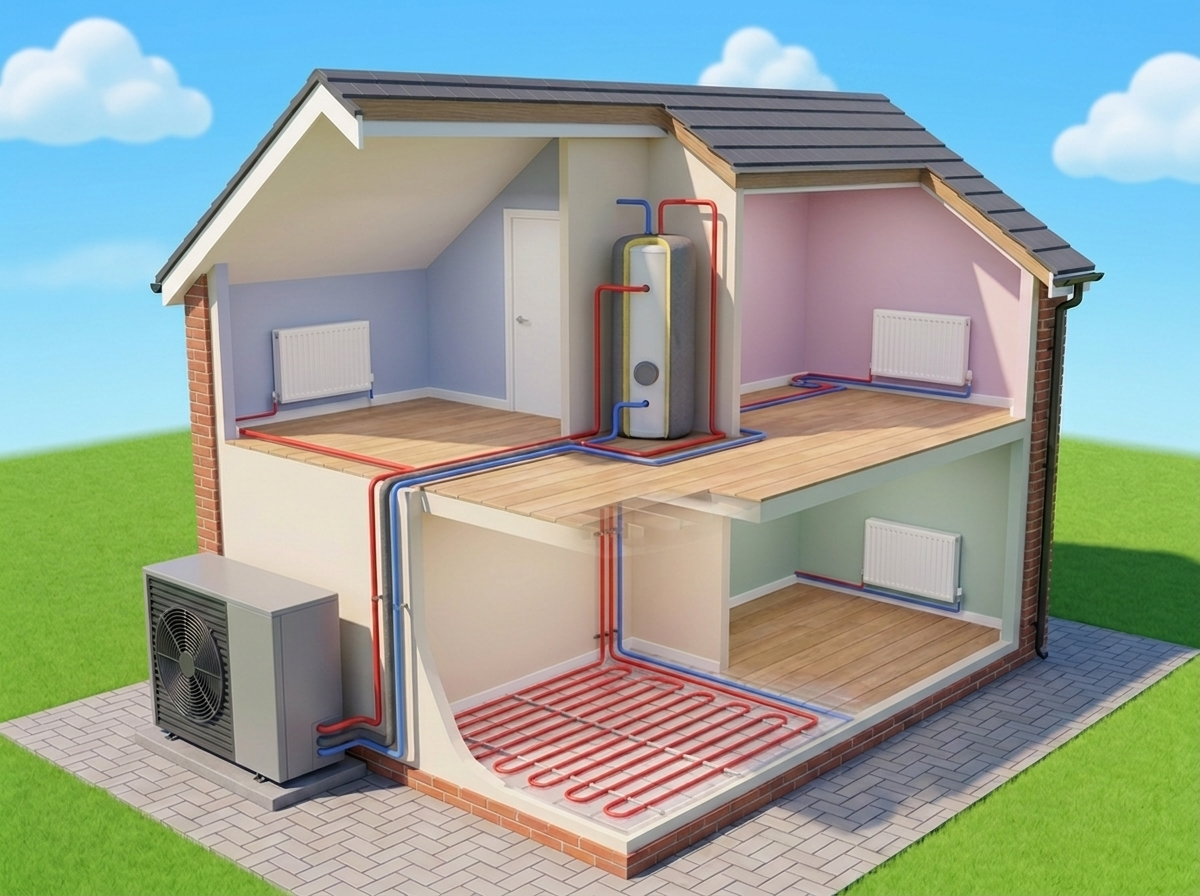
Start with your fridge
The easiest way to understand a heat pump is to look at something already in your kitchen. A fridge keeps food cold by taking heat out of the box and dumping it into the room. Put your hand behind one and you can feel the warmth it has removed.
A heat pump does exactly the same job, pointed the other way. It takes heat out of the air in your garden and dumps it into your central heating. Nothing is burned. Heat is simply picked up in one place and put down in another.
A heat pump doesn't make heat. It moves heat that already exists — and moving is far cheaper than making.
But it's cold outside
This is the part that trips most people up, and it is a fair question. If it is 2°C outside, how can there be any heat to collect?
The answer is that "cold" is only cold relative to us. Air at 2°C still contains a great deal of heat energy — it only stops holding any at around −273°C, which is as cold as anything in the universe gets. A British winter morning is, in those terms, still remarkably warm.
The trick is having something inside the heat pump that is colder than the outside air, so that heat naturally flows into it. That something is a refrigerant, and it boils at roughly −50°C. Compared to that, a frosty morning is warm enough to make it evaporate.
The four things that happen
Inside the outdoor unit, the same small amount of refrigerant goes round a sealed loop, over and over. It changes between liquid and gas as it goes, and those changes are what carry the heat.
A fan draws outside air over a coil
The coil is full of very cold liquid refrigerant. Heat moves out of the air and into the refrigerant, because heat always travels from warmer to colder.
The refrigerant boils into a gas
It doesn't take much warmth to boil something at −50°C. As it turns to gas it absorbs a surprising amount of energy — the same way a kettle takes far more energy to boil water than to warm it.
A compressor squeezes the gas
Squeezing a gas makes it hot, which is why a bicycle pump warms up in your hand. The compressor concentrates all that gathered warmth into a small, genuinely hot volume of gas. This is the only step that uses meaningful electricity.
The heat is handed to your water
The hot gas passes a heat exchanger with your central heating water on the other side. The heat crosses over, the refrigerant cools back to a liquid, and it starts the loop again. The warmed water goes off to your radiators, underfloor heating and hot water cylinder.
From your side of the wall, that last step is the only one you would notice. Warm water arrives in the pipes and the house heats up, exactly as it did with a boiler.
Why the sums work
A gas boiler can never give out more energy than the gas it burns. The best condensing boilers convert around 90% of the fuel into useful heat, and the rest goes up the flue. Boilers are, in other words, capped at slightly under 100% efficient.
A heat pump is not making heat, so it isn't bound by that limit. It spends electricity running a fan and a compressor, and in return it delivers the heat it has collected from outside. For every unit of electricity in, a well-installed system returns three to four units of heat.
That ratio is what installers call the coefficient of performance, and it is the entire economic case for a heat pump. It also explains why installation quality matters so much: the same appliance can return 3.8 in a properly designed system and 2.4 in a badly designed one, on the same house, in the same weather.
What it feels like to live with
A boiler heats water to around 70°C and blasts it round the house in short bursts. A heat pump works differently, and this is the change people actually notice.
- The water runs cooler. Typically 40–50°C rather than 70°C. Radiators feel warm rather than too hot to touch.
- It runs for longer. Instead of firing hard and stopping, it ticks along gently and holds the house at temperature. Steady beats fierce, and it is cheaper to run that way.
- You stop turning it off. The old habit of heating the house twice a day works against a heat pump. They are most efficient left to maintain a steady temperature.
- Hot water is stored, not instant. A cylinder replaces the on-demand hot water a combi gave you, so you need a cupboard for it.
Because the water is cooler, each radiator gives out less heat than it did before. That is why a heat-loss survey matters: we measure every room and check whether the existing radiator is big enough at the lower temperature. Most are. The ones that aren't get upgraded, and that is far cheaper than discovering the problem in January.
Where a heat pump doesn't stack up
They are not right for every house, and anyone who tells you otherwise is selling. A home losing heat through solid uninsulated walls and a draughty loft will need a very large system and will still cost a lot to run — insulation first, heat pump second. If there is genuinely nowhere to put a cylinder, or no outside space for the unit within a sensible pipe run, that is a real obstacle. And because a heat pump runs on electricity, which currently costs about four times as much per unit as gas, the efficiency has to be good for the bills to work. That is a design problem, and it is the one we spend the most time on.
The short answer
A heat pump is a fridge running in reverse. It uses a refrigerant that boils at −50°C to collect warmth from outside air, a compressor to concentrate that warmth into something useful, and a heat exchanger to hand it over to your heating water. Because it moves heat rather than making it, it delivers three to four times more energy than it consumes.
Everything else — the radiators, the thermostat, the hot taps — carries on much as before.